


Microsoft 365 privacy information
Summary
- The Julius-Maximilians-Universität Würzburg administers the applications available through Microsoft 365 and facilitates access to third-party services.
- Use of Microsoft's online services creates a digital footprint.
- In addition to the University, Microsoft Ireland Operations Limited and Microsoft Corporation are involved in the processing of personal data.
- Your Microsoft Education Account profile is generally visible to other members of the University and authorised communication partners where this is necessary for collaboration and communication.
- Microsoft Teams enables communication between you and external parties.
- Certain components of Microsoft 365 are used as public electronic communications services.
Controller
Julius-Maximilians-Universität Würzburg
(public law institution)
The University is represented by its President.
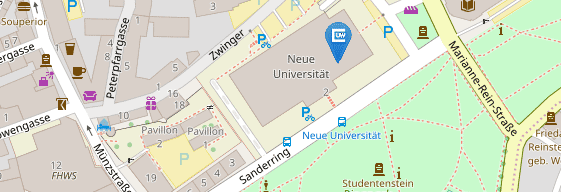
Sanderring 2
97070 Würzburg
Germany
Telephone: +49 931 31-0
Fax: +49 931 31-82600
Contact Details of the Data Protection Officer
Data Protection Officer of Julius-Maximilians-Universität Würzburg
Sanderring 2
97070 Würzburg
Germany
Telephone: +49 931 31-0
Controllers and Their Data Protection Officers (in Addition to the Licensee)
Microsoft Ireland Operations Limited
One Microsoft Place
South County Business Park
Leopardstown
Dublin 18
Ireland
This entity is controlled by:
Microsoft Corporation
One Microsoft Way
Redmond, Washington 98052
United States of America
Data Protection
Microsoft provides a dedicated privacy information page, including FAQs and contact options.
Further information regarding Microsoft's processing of personal data is available in Microsoft's Privacy Statement, Product Terms, Data Protection Addendum, and other privacy and compliance documentation made available by Microsoft.
Data Subject Rights
General
As a data subject, you are entitled to the rights set out in Articles 15 et seq. GDPR in relation to the processing of your personal data, provided that such rights are not exercised in an abusive, manifestly unfounded or excessive manner:
- You have the right to obtain confirmation as to whether we process personal data relating to you. Where this is the case, you have the right of access to such personal data and to further information concerning the processing (Article 15 GDPR). Please note that this right of access may be restricted or excluded in certain circumstances (in particular under Article 10 BayDSG).
- Where personal data relating to you is inaccurate or incomplete, you have the right to obtain rectification and, where applicable, completion of such data (Article 16 GDPR).
- Where the statutory requirements are met, you may request the erasure of your personal data (Article 17 GDPR) or restriction of processing (Article 18 GDPR). However, the right to erasure under Article 17(1) and (2) GDPR does not apply, among other cases, where processing is necessary for the performance of a task carried out in the public interest or in the exercise of official authority (Article 17(3)(b) GDPR). In particular, archival obligations may take precedence over erasure.
- Where processing is based on your consent or on a contract and is carried out by automated means, you may have the right to data portability (Article 20 GDPR).
- Where personal data is transferred outside the European Economic Area (EEA), information regarding the safeguards in place, and a copy of such safeguards where applicable, will be provided upon request using the contact details above.
- You have the right to lodge a complaint with a supervisory authority within the meaning of Article 51 GDPR concerning the processing of your personal data. The competent supervisory authority for public bodies in Bavaria is the Bavarian State Commissioner for Data Protection (Bayerischer Landesbeauftragter für den Datenschutz), Wagmüllerstraße 18, 80538 Munich, Germany. In addition to the right to lodge a complaint, you may seek a judicial remedy.
Right to Withdraw Consent
Where processing is based on consent, you have the right to withdraw your consent at any time. Withdrawal of consent shall only take effect for the future; it does not affect the lawfulness of processing carried out on the basis of consent before its withdrawal.
Right to Object Pursuant to Article 21 GDPR
On grounds relating to your particular situation, you have the right to object at any time to the processing of personal data relating to you (Article 21 GDPR). Where the applicable legal requirements are met, we will no longer process your personal data.
Requirement to Provide Personal Data
Without the creation of an account, licensed use of Microsoft 365 is not possible.
For members, affiliates, guests and cooperation partners of the University, failure to provide the personal data required for use may also result in contractual, employment-related, official or other obligations being impossible to fulfil.
Purpose of Processing
The procurement and use of Microsoft 365 as a comprehensive collaboration and communication platform supporting teaching, research and administrative activities. This includes the use of licensed products and services, provision of updates, maintenance of information security, and the delivery of technical and customer support.
Usage statistics are also generated.
Certain components of Microsoft 365 may be used as public electronic communications services.
Personal data may be disclosed to Microsoft for the following purposes:
a) Billing and account management
b) Internal compensation and partner remuneration
c) Internal reporting and modelling
d) Fraud prevention and detection
e) Prevention and detection of cybercrime and cyberattacks
f) Improvement of core functionality, particularly regarding accessibility, privacy and energy efficiency
g) Financial reporting
h) Compliance with legal obligations
Legal Basis for Processing
For licensed users, processing is carried out on the basis of Article 6(1)(b) GDPR.
For employees, processing is carried out on the basis of Articles 6(1)(b), (c) and (e) GDPR in conjunction with the applicable employment, collective bargaining and civil service legislation.
For other members, affiliates, guests and communication partners, processing is carried out on the basis of Article 6(1)(e) GDPR in conjunction with Article 4 BayDSG.
Where special categories of personal data are processed, such processing is carried out on the basis of Article 9(2) GDPR.
Where information is stored on, or accessed from, end-user devices, processing is carried out on the basis of Section 25(2) TDDDG.
Where electronic communications services are provided, additional telecommunications confidentiality obligations apply.
The processing of aggregated data is carried out on the basis of Article 6(4) GDPR and any other applicable statutory provisions.
Disclosures are made where required by law.
Categories of Personal Data
- Account data
- Usage data, including authentication data
- Content data (documents, files, tasks, solutions and support requests)
- Communication data
- System-generated log data, including usage history, service quality, diagnostic data and service-generated data
- End-user device information
- Device and status information
- Traffic data and signalling/control data
Categories of Data Subjects
- Individuals who use or administer Microsoft 365.
- Individuals who are identifiable in communications or content, including documents, files, messages, images, recordings or transcripts.
Source of Personal Data
Personal data is generally provided directly by the data subjects themselves or generated through the use of Microsoft 365.
Account and identity data may be obtained from identity and directory services operated by Julius-Maximilians-Universität Würzburg.
In addition, personal data is generated automatically through the use of Microsoft 365, particularly through the processing of usage data, communication data, traffic data, control data and log data.
Recipients
- Communication and collaboration partners with whom you communicate or exchange content through Microsoft 365.
- Microsoft Ireland Operations Limited and Microsoft Corporation in connection with the provision and operation of Microsoft 365 and the fulfilment of their respective responsibilities under Microsoft's contractual data protection arrangements.
- Sub-processors and support service providers engaged by Microsoft. The current list of Microsoft's sub-processors and other service providers can be found in Microsoft's privacy and compliance documentation.
- Service providers engaged by Julius-Maximilians-Universität Würzburg for the operation, support, consultancy, training, migration, administration or other assistance relating to Microsoft 365, where such involvement is necessary.
- Courts, supervisory authorities, law enforcement authorities, and legal or professional advisers, where required or permitted by law.
Safeguards for International Transfers
Where personal data is transferred to third countries, such transfers are carried out on the basis of appropriate safeguards in accordance with Chapter V GDPR.
This includes, in particular, reliance on the EU-U.S. Data Privacy Framework, the European Commission's Standard Contractual Clauses (Implementing Decision (EU) 2021/914), and, where necessary, supplementary protective measures.
Microsoft Corporation is certified under the EU-U.S. Data Privacy Framework.
Where transfers are made to sub-processors and support providers, the requirements of Articles 44 et seq. GDPR are complied with.
During communications, personal data may be transferred worldwide to communication partners. For electronic communications services, additional telecommunications confidentiality obligations apply.
Retention Periods
- Account data: 180 days after it is no longer required.
- Usage data, including authentication data: 180 days after account deletion.
- Content data: Until no longer required, taking into account statutory retention and archiving obligations.
- Communication data: 180 days after the end of the communication.
- System-generated log data: Generally 180 days.
- End-user device information: Until no longer required.
- Device and status information: 180 days after the end of centralised management.
- Traffic data and signalling/control data: Generally 180 days.
Automated Decision-Making
No automated decision-making, including profiling within the meaning of Article 22(1) and (4) GDPR, is carried out.
Notice Regarding the Service Provider's Security and Abuse
Microsoft may, in fulfilment of its own legal obligations and on the basis of its own responsibilities as an independent controller under data protection law, operate certain automated detection mechanisms to identify indications of serious criminal offences, in particular material relating to child sexual abuse, and to make reports where required by law.
Such processing is not carried out on behalf of the University, is not subject to the University's instructions, and does not serve the University's purposes. Further information regarding this processing is provided by Microsoft in its Privacy Statement and in the contractual documentation relating to Microsoft Online Services.
As a general rule, the University is not informed of routine reviews or screening activities carried out by Microsoft. Where Microsoft notifies the University of specific incidents and such notification gives rise to legal obligations on the part of the University, any subsequent processing will be carried out solely in accordance with the applicable legal requirements.
Researchers are advised that, in certain academic disciplines, lawful research datasets may contain content that could be technically identified by automated detection mechanisms as potentially abuse-related. Appropriate case-by-case arrangements should therefore be established for such research activities.