



AI-supported tools at JMU: Information and orientation of the computer centre
For responsible use, the terms of use of the respective providers as well as relevant legal and university requirements must be observed. The responsibility for the actual use lies with the user.
Please note:
Non-compliant use of AI systems can - depending on the context - result in legal as well as examination, service or labour law consequences.
Specific regulations on the use of AI beyond the legal framework, in particular in studies, teaching or in an official context, are determined by the respective responsible institutions, lecturers or persons in charge.
Article 50(4) of Regulation (EU) 2024/1689 (AI Regulation)
The University of Würzburg, as an Deplyer of AI systems, is subject to the transparency and labelling requirements set out in Article 50(4) of Regulation (EU) 2024/1689 (AI Regulation) (external link).
When using AI-generated content, an appropriate and accessible notice must be attached to the work, for example:
“This content was created wholly or in part using artificial intelligence.”
Depending on the specific circumstances, additional or more specific notices may be required, or exemptions may apply (e.g. for editorially revised texts).
Labelling obligations arising from the principles of good scientific practice remain unaffected.
If you have questions regarding implementation, please refer to the relevant circulars issued by the University. You may also contact your line manager or supervisor.
Further information is available from the European Commission in the code of conduct (external link to document) and icons for labelling (external link).
The Information Technology Centre merely provides the service; users are responsible for its lawful use.
General information on AI systems at the Julius-Maximilians-Universität
Where possible, it is recommended to use the services provided by the computer centre for AI-supported applications. These are integrated into the university's IT infrastructure and take into account JMU's organisational and technical framework conditions.
Depending on the application, different support services are available:
- Standard applications: Use of the AI services provided by the computer centre
- Extended functions in centrally provided AI services: please contact the computer centre
- Video transcription: support from the data centre
- Local AI applications (e.g. on workstations or servers): Coordination with the responsible network managers or IT department supervisors
The use of external AI services is possible in principle, but is the responsibility of the user, subject to the respective terms of use and the applicable legal and organisational requirements. Apart from the AI systems listed here, centralised procurement via the available AI services is currently not planned.
- Please clarify the next steps with Purchasing and the budget managers.
- We also recommend that you clarify issues relating to occupational safety, accessibility, data protection, information security, the AI Ordinance, co-determination and copyright in advance.
If you would like centralised procurement, please contact the Presidential Board or the IT Advisory Board to change the strategic direction of JMU.
What possibilities do AI systems offer?
The data centre enables the use of AI systems based on AI models for general purposes, which can be used as highly efficient models for a variety of tasks.
The AI systems can map the following functions:
- Documents: writing texts, creating tables and diagrams, designing presentations, structuring and summarising content
- Information search: answering questions, searching the internet, analysing content and preparing it in an understandable way
- Creativity: developing project ideas, providing text support, creating design proposals and concepts
- Images & media: generating and editing images, creating graphics and producing or transcribing audio and video content
- Technology: Troubleshooting, instructions, technical questions
- Translation & multilingualism: translating texts, enabling multilingual communication and publication
- Data analysis & reports: Analysing data, creating diagrams, reports and summaries
- Education & learning: Explain content, create learning materials and summaries, provide step-by-step explanations, support learning processes and impart knowledge
- Automation & assistance: Generate answers, analyse documents, create reports and support work processes
- Data protection & compliance: anonymise content for data protection-compliant processing
Microsoft Copilot (Basic)
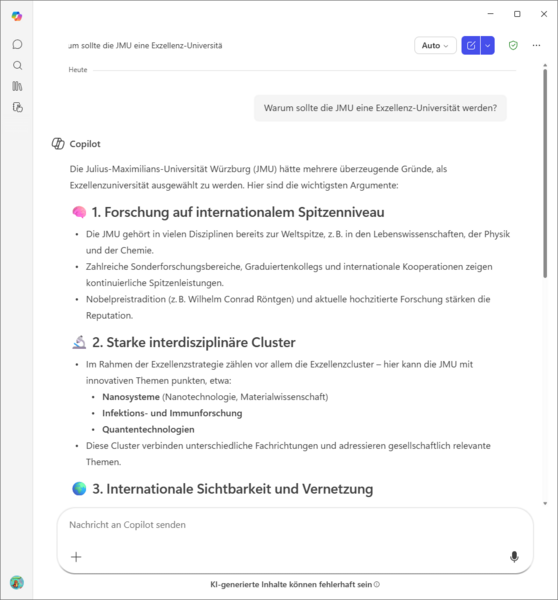
- Microsoft Copilot (Basic) is an AI-supported assistance function for Microsoft 365 applications and services, Windows and Microsoft Bing. The aim is to provide support with tasks, complete them faster and increase productivity.
- Login at https://copilot.cloud.microsoft/
- The underlying technology is based on current AI models (e.g. GPT-based models and image generation) and generates customised responses using web data.
- ❗ Registration with the Wue login is mandatory for legally compliant business use.
- Registration with Copilot with Wue login for business use
- Use takes place within the Microsoft environment provided (depending on licence, e.g. Microsoft 365 A3)
- Requests and responses are only processed and stored for a short time
- Limited support from Microsoft in the event of possible copyright infringements of the content created
- Confidentiality of content (no use of web data) can be influenced by appropriate prompts, e.g. "Answer the question without web search"
- The Microsoft 365 Copilot integrated into Microsoft services is not provided by the data centre, nor is Microsoft Copilot Studio.
Adobe Firefly
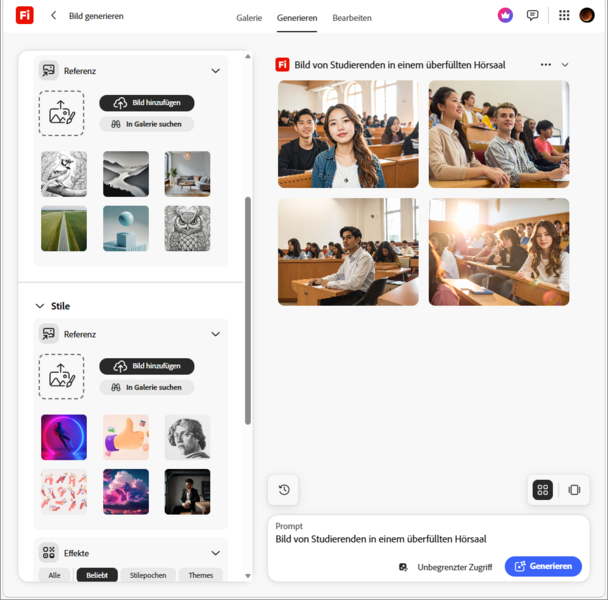
- This information relates to the AI functions that are integrated into the programmes installed on workstations, such as PhotoShop, etc., i.e. they can be used directly from the programme.
- Can be used by JMU members who order a licence for Adobe (Creative Cloud).
- Further information about Firefly at https://firefly.adobe.com/
- Registration via Adobe user account of the JMU with WueLogin.
- Each user receives 1000 credits per month from Adobe at no additional cost.
- Each user must accept additional terms of use from Adobe before using the AI functions for the first time.
- Commercial use expressly permitted
- Limited exemption from liability for copyright infringements of the content created
AI services of the EU Commission
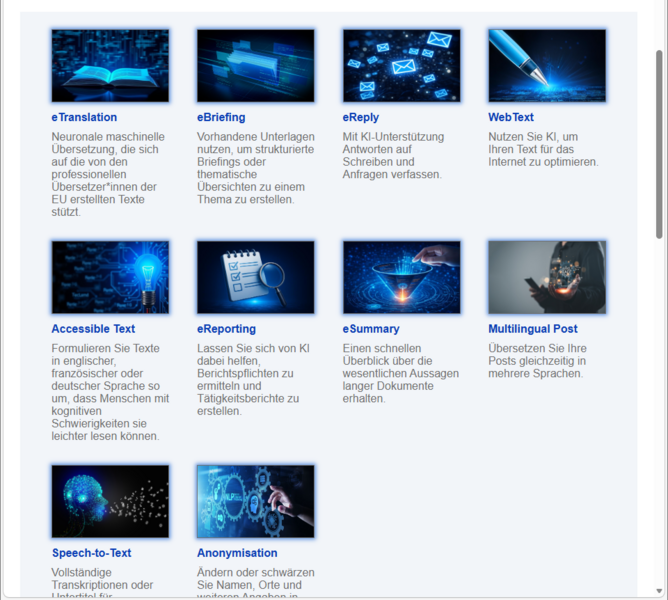
The EU Commission offers a range of AI-powered language services aimed at making multilingual communication within the EU more efficient and accessible. These services include machine translation, document summarisation, AI-assisted answering and much more.
- Access via: https://language-tools.ec.europa.eu/
- An EU login account is required to use the service. You may use the university email address for this.
- The EU Commission provides documentation .
Important to know:
- The service may only be used with public information.
- The service is not offered by the University of Würzburg and is the responsibility of the EU Commission.
Duck.ai
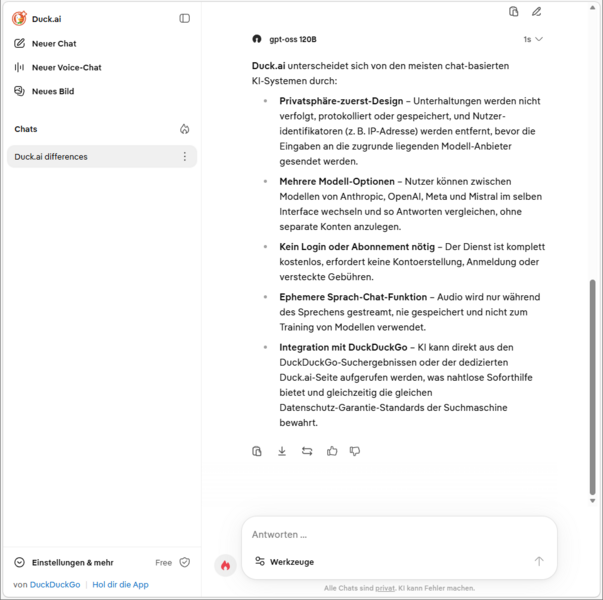
Duck.ai is an AI-supported chat service from DuckDuckGo that enables access to various language models (e.g. GPT, Claude, Llama, Mistral) via a standardised interface. The service is web-based, can be used free of charge and focuses in particular on privacy-friendly, anonymous use.
Access at https://duck.ai
The underlying technology is based on external AI models that are connected via DuckDuckGo and generate answers based on the prompts entered.
Registration is not required; it can be used without a user account.
- Use without login and without creating user profiles
- Choice between several AI models with different characteristics
- Requests are anonymised and forwarded to external AI providers
- No permanent storage of chats on servers; storage may take place locally in the browser
- Input is not used to train the AI models
Important to know:
Despite the focus on data protection, the application may only be used with public information.
How can my preferred system be replaced at JMU?
| category | Service provider | Service | Brief description | Core function | JMU alternative |
|---|---|---|---|---|---|
| Assistants (chat) | OpenAI | ChatGPT | Universal AI chat for text, analysis and ideas | Generative chat | Microsoft Copilot Basic (Chat) / Duck.ai |
| Assistants (Chat) | Microsoft | Copilot | AI chat with integrated web search | Chat + web search | Microsoft Copilot Basic (Chat) |
| Assistants (Chat) | Anthropic | Claude | Strong analysis and writing chat with great context | Long context / analysis | Microsoft Copilot Basic (Chat) / Duck.ai |
| Assistants (Chat) | DuckDuckGo | Duck.ai | Privacy-focussed AI chat | Privacy chat | Duck.ai |
| Assistants (Chat) | EU | eSummary | Automatic summarisation of documents | Summary tool | EU-Language-Tool |
| Coding AI | OpenAI | Codex | AI for code creation and analysis | Generate code | GWDG Chat-AI |
| Coding AI | Microsoft | GitHub Copilot | AI assistance directly in the editor | IDE assistance | Individual solution |
| Image AI | OpenAI | DALL-E | Image generation directly via chat | Image generation | Microsoft Copilot Basic (Chat) / Adobe Firefly / Duck.ai |
| Image AI | Adobe | Firefly | Professional AI for design and content | Design AI | Adobe Firefly |
| Speech & Audio | ElevenLabs | Voice AI | High-quality speech synthesis | Text-to-Speech | Individual solution |
| Speech & Audio | EU | eTranslation | Neural translation | Translation Tools | EU Language Tools |
| Language & Audio | EU | Speech-to-Text | Audio Transcription | Transcription | EU-Language-Tools |
| Business & Coworker | Microsoft | Copilot | AI assistance for knowledge work | Knowledge work | Microsoft Copilot Basic (Chat) |
| Business & Coworker | EU | eBriefing | Create structured briefings | Briefings | EU-Language-Tool |
| No-code AI & automation | Zapier | Zapier AI | Automation of workflows across multiple systems | Workflow automation | Individual solution |
| No-code AI & automation | Make | Make (with AI) | Visual process automation | Process automation | Individual solution |
| No-code AI & automation | n8n | n8n + AI | Open source automation platform | Workflow engine | Individual solution |
| Agents & autonomous systems | OpenAI | GPTs / Agents | Customisable AI agents | Automation | Microsoft Copilot Basic (Chat) (partial) |
| Agents & autonomous systems | Anthropic | Claude Cowork | Autonomous execution of tasks | Workflow automation | Individual verification required |
| AI search | AI Search | AI-supported web search | Search | Microsoft Copilot Basic (Chat) / Duck.ai | |
| AI search | Perplexity AI | Perplexity | AI-supported web search | Search | Microsoft Copilot Basic (Chat) / Duck.ai |
Principles for the use of AI
General
- The same requirements apply as for official research on the open Internet.
- Use must be considered, careful and critical.
- No support can be provided for the use of AI functions, as the technology is constantly being further developed and individual requests cannot be covered. As a rule, however, AI systems also have good self-help functions.
Users are responsible for entering the prompts:
- Prompts should not contain any unpublished personal data (e.g. names, addresses, telephone numbers).
- Prompts must not disclose confidential content (e.g. internal documents, business secrets).
- Prompts must not be used to manipulate the AI application.
- Prompts should not bypass any protection mechanisms of the AI application.
Users are responsible for the use of the content:
- Content may be fictitious and should therefore always be checked.
- Content can be discriminatory and should be treated with caution.
- Content may be criminal and must not violate applicable laws.
- Content may infringe the rights of third parties, such as copyrights or personal rights.
Users must be transparent:
- The use of AI-generated content must be disclosed, e.g. by means of a note in the document or presentation.
- Administrative actions and personalised assessments must not be based on AI-generated content.
Further training
University employees can deepen their knowledge via BayLern. The AI course can be accessed via this link.
For more than the AI tools described above, you should first look at the learning opportunities offered by the AI Campus. According to the "EU AI Act", which came into force in August 2025, employers are obliged to refer to such training offers.